Introduction
The internal combustion engine is the most important aspect of a car. Just like how the human heart pumps oxygenated blood providing us with the energy to move, the engine is the heart of a car and supplies the torque required for motion and power.
Let's be honest, unless you are a technician or a certified mechanic, the engine in a car will indeed be rocket science to any common man with lots of metal, tubes and wires running all around the engine bay.
Internal combustion engines
Internal combustion engines essentially mixes petrol with hot gases within the cylinder chamber, and when ignited via the spark plug - provides the necessary force for your car to move.
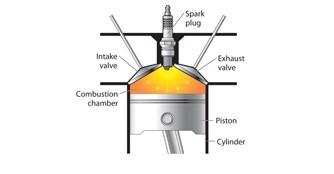
 Automotive Engineering 101: The internal combustion engine - the heart of the vehicle - provides the force needed to commuteThe piston - which looks like a metal clenched fist - slides down when the intake valve opens. This fills the engine with a cylinder full of air and a tiny drop of petrol is injected into the mix. With this mixture, the piston moves back up - compressing the mixture in the process.
When the piston reaches the top again, the spark plug ignites, resulting in an explosion in the cylinder causing the piston to be pushed down again. Once again, the piston hits the bottom of its stroke, the exhaust valve opens, and the exhaust leaves the cylinder. And this cycle keeps continuing, until you turn off the engine.
What is Carbon?
Carbon is the sixth element of the periodic table and the toughest known element known to man. A derivative and expensive product - carbon fibre is worshipped by elite manufactures like McLaren and Ferrari to Pagani and Koenigsegg, among others, in a bid to lessen gross weight without compromising integrity and strength of the chassis.
For some reason carbon can also be found in our engine cylinder banks.
The internal combustion engine is the most important aspect of a car. Just like how the human heart pumps oxygenated blood providing us with the energy to move, the engine is the heart of a car and supplies the torque required for motion and power.
Let's be honest, unless you are a technician or a certified mechanic, the engine in a car will indeed be rocket science to any common man with lots of metal, tubes and wires running all around the engine bay.
Internal combustion engines
Internal combustion engines essentially mixes petrol with hot gases within the cylinder chamber, and when ignited via the spark plug - provides the necessary force for your car to move.
When the piston reaches the top again, the spark plug ignites, resulting in an explosion in the cylinder causing the piston to be pushed down again. Once again, the piston hits the bottom of its stroke, the exhaust valve opens, and the exhaust leaves the cylinder. And this cycle keeps continuing, until you turn off the engine.
What is Carbon?
Carbon is the sixth element of the periodic table and the toughest known element known to man. A derivative and expensive product - carbon fibre is worshipped by elite manufactures like McLaren and Ferrari to Pagani and Koenigsegg, among others, in a bid to lessen gross weight without compromising integrity and strength of the chassis.
For some reason carbon can also be found in our engine cylinder banks.
The presence of Carbon in engines
Carbon is a naturally occurring by-product in out engines. There are no theoretical reasons to why this happens but some possibilities include being light-footed, stop-and-go driving or lugging the engine.
Your engine does not perform at optimum temperatures during city or low-rev driving; thus the opportunity for carbon to be present in your engine is higher.
Carbon will appear to form as a thin coat of black soot and an increase in build-up can lead to decreased fuel mileage, excessive emissions, lack of power, stalling and poor acceleration.
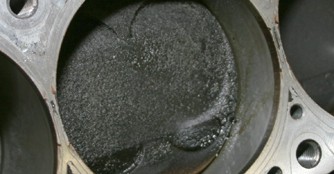 Like nicotine in a smokers lung, carbon can 'choke' the cylinders, comprimising on the performance and feel of the vehicleAs carbon builds up it resides on your piston head, and valves. This restricts the internal components of the engine to function at optimum levels as the carbon adds more resistance and the piston cannot fully push and pull.
Unfortunately while cars nowadays are littered with technology like camera's and sensors, there is nothing on your dashboard that informs you of the carbon build up in your engine - but you can definitely feel the sluggish performance over time.
Clearing carbon from your engine
An engine overhaul or complete engine flush every 10,000km is usually the only time the carbon can be flushed. Chemicals will be injected to flush the system and some parts may have to be manually cleaned. Besides, certain chemicals can corrode the internal walls of the engine - damaging it further.
Another method to clear the carbon is redlining your vehicle to ensure the resulting heat in the engine melts away the carbon build up.
Though it sounds like a load of fun, this eventually damages your engine quicker due to high temperatures - which might not be tolerated by most volume sellers i.e. Toyota Corolla Altis, Kia Cerato Forte - thus resulting to faster wear and tear.
Carbon is a naturally occurring by-product in out engines. There are no theoretical reasons to why this happens but some possibilities include being light-footed, stop-and-go driving or lugging the engine.
Your engine does not perform at optimum temperatures during city or low-rev driving; thus the opportunity for carbon to be present in your engine is higher.
Carbon will appear to form as a thin coat of black soot and an increase in build-up can lead to decreased fuel mileage, excessive emissions, lack of power, stalling and poor acceleration.
Unfortunately while cars nowadays are littered with technology like camera's and sensors, there is nothing on your dashboard that informs you of the carbon build up in your engine - but you can definitely feel the sluggish performance over time.
Clearing carbon from your engine
An engine overhaul or complete engine flush every 10,000km is usually the only time the carbon can be flushed. Chemicals will be injected to flush the system and some parts may have to be manually cleaned. Besides, certain chemicals can corrode the internal walls of the engine - damaging it further.
Another method to clear the carbon is redlining your vehicle to ensure the resulting heat in the engine melts away the carbon build up.
Though it sounds like a load of fun, this eventually damages your engine quicker due to high temperatures - which might not be tolerated by most volume sellers i.e. Toyota Corolla Altis, Kia Cerato Forte - thus resulting to faster wear and tear.
KlearKarbon
KlearKarbon is a new start up and it's the first specialist workshop in Singapore that offers pure hydrogen engine cleaning service - taking an alternate approach to engine overhaul and maintenance.
KlearKarbon is managed by Ken and Jason, a former marketing executive and racer respectively. On top of having the same last name, Tan, it was their common interests for cars and a bid to save the environment that brought them together.
Hydrogen Cleaning
Hydrogen cleaning is not entirely a new concept but its application on automobiles is unheard of here. Hydrogen has been widely utilised to remove impurities on solid surfaces like archaeology, semiconductor and IT industry.
The hydrogen atoms reacts to carbon, silicon and oxygen atoms which breaks down any carbon deposits and turns it into either gas or vapour which is then exited through the exhaust.
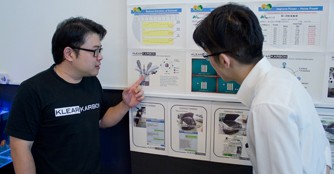 Ken (left), one of the two guys managing KlearKarbon, explains how hydrogen reacts and breaks down the carbon smudge To simply put, the hydrogen cleaning is akin to a dialysis machine for your engine. Yet, unlike dialysis machines for kidneys which takes in dirty blood, cleans it, and pumps clean blood back into your body, the hydrogen machine pumps in air which contains a small dosage of hydrogen that naturally attaches to and breaks down the carbon particles.
It also prevents the internal walls of the cylinder chamber from corroding because of how hydrogen elements react to carbon.
KlearKarbon is a new start up and it's the first specialist workshop in Singapore that offers pure hydrogen engine cleaning service - taking an alternate approach to engine overhaul and maintenance.
KlearKarbon is managed by Ken and Jason, a former marketing executive and racer respectively. On top of having the same last name, Tan, it was their common interests for cars and a bid to save the environment that brought them together.
Hydrogen Cleaning
Hydrogen cleaning is not entirely a new concept but its application on automobiles is unheard of here. Hydrogen has been widely utilised to remove impurities on solid surfaces like archaeology, semiconductor and IT industry.
The hydrogen atoms reacts to carbon, silicon and oxygen atoms which breaks down any carbon deposits and turns it into either gas or vapour which is then exited through the exhaust.
It also prevents the internal walls of the cylinder chamber from corroding because of how hydrogen elements react to carbon.
Benefits of hydrogen cleaning
Do not get the concept of hydrogen cleaning wrong, unlike turbo charging or ECU remapping, Klear Karbon's hydrogen cleaning process does not add performance or extra bhp to your car.
What it does - restore performance that was lost due to the carbon build-up within your engine.
This in turn gives you a better fuel mileage, better emissions, quieter engine, and smoother response.
In short, hydrogen cleaning from KlearKarbon 'overhauls' your engine at a fraction of the cost and time in comparison to traditional engine overhaul services.
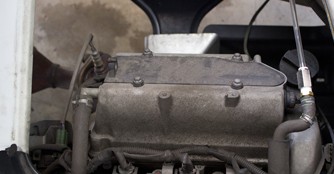 This is all that is needed - a hose (extreme right) from the maching attached to the engine. The clean process is also fast, more affordable and envorenmentally friendlyAnd an added bonus for Ken and Jason is - their hands are cleaner as all they have to do is attach a hose from the hydrogen emitting machine to the engine of your vehicle, and the power cable to the battery, and run the machine.
The core technology that breaks down the water molecules and produces the hydrogen is patented in USA and Japan while the entire machine is from Taiwan. The only by product of this machine - Oxygen.
Do not get the concept of hydrogen cleaning wrong, unlike turbo charging or ECU remapping, Klear Karbon's hydrogen cleaning process does not add performance or extra bhp to your car.
What it does - restore performance that was lost due to the carbon build-up within your engine.
This in turn gives you a better fuel mileage, better emissions, quieter engine, and smoother response.
In short, hydrogen cleaning from KlearKarbon 'overhauls' your engine at a fraction of the cost and time in comparison to traditional engine overhaul services.
The core technology that breaks down the water molecules and produces the hydrogen is patented in USA and Japan while the entire machine is from Taiwan. The only by product of this machine - Oxygen.
The restrictions of hydrogen cleaning
The only downside of hydrogen cleaning is - it does not work for Wankel type/Rotary powertrains or hybrid powertrains. During the treatment process, the engine will be idle. On a rotary engine, the combustion chambers will be filled with petrol when the car is driven fewer than 3,000rpm or left to idle for extended periods.
The benefit of a hybrid car is to be environmentally friendly on top of offering a better fuel efficiency than naturally aspirated vehicles. Most hybrids are now fitted with larger batteries that have a decent operating range and work solely on battery power at the low revs - making it pointless for a hydrogen treatment.
Extending the life of your car
With COE prices on the rise and the concept of car ownership slipping through the hands of many, car maintenance has taken a crucial importance with existing car owners as more are reluctant to change their cars.
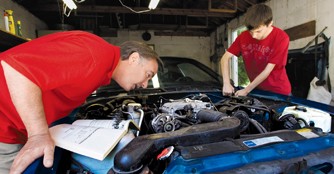 Car maintenance has regained importance amidst a time where COE prices are reaching new highs and most car buyers clinging on to current carsAlso KlearKarbon provides maintenance services akin to an engine overhaul but at the fraction of the price and time saving you money and inconvenience of not having a vehicle for days.
Diesel powered cars are encouraged to utilise hydrogen cleaning as the presence of carbon soot and black smoke is higher than petrol powered cars.
Is it safe?
While the machines disperse air with a small dosage of hydrogen into your engine and despite knowing how hydrogen is highly combustible and the insides of the engine to be a really hot and highly combustible place itself.
Why then would anyone want to mix these two together?
The only downside of hydrogen cleaning is - it does not work for Wankel type/Rotary powertrains or hybrid powertrains. During the treatment process, the engine will be idle. On a rotary engine, the combustion chambers will be filled with petrol when the car is driven fewer than 3,000rpm or left to idle for extended periods.
The benefit of a hybrid car is to be environmentally friendly on top of offering a better fuel efficiency than naturally aspirated vehicles. Most hybrids are now fitted with larger batteries that have a decent operating range and work solely on battery power at the low revs - making it pointless for a hydrogen treatment.
Extending the life of your car
With COE prices on the rise and the concept of car ownership slipping through the hands of many, car maintenance has taken a crucial importance with existing car owners as more are reluctant to change their cars.
Diesel powered cars are encouraged to utilise hydrogen cleaning as the presence of carbon soot and black smoke is higher than petrol powered cars.
Is it safe?
While the machines disperse air with a small dosage of hydrogen into your engine and despite knowing how hydrogen is highly combustible and the insides of the engine to be a really hot and highly combustible place itself.
Why then would anyone want to mix these two together?
We were assured by KlearKarbon that the amount of hydrogen present in the air dispersing from the machine is too minute (much lesser than the theoretical 4 percent) to cause any explosions. Besides we tried it on one of our company's vehicles and post treatment it works well, if not better.
Saving Gaia - One car at a time
Through 'de-karbonizing' the engine, KlearKarbon aims to reduce the carbon footprint of Singapore and clean up the environment in the process - one car at a time. KlearKarbon is not your usual workshop which features spilled oil, car jacks, and tools lying around.
Instead KlearKarbon has four machines the size of a home theatre system subwoofer on a trolley, some hoses, a small indoor water fountain and a wall mounted television surrounded by comfortable couches.
Testimonials
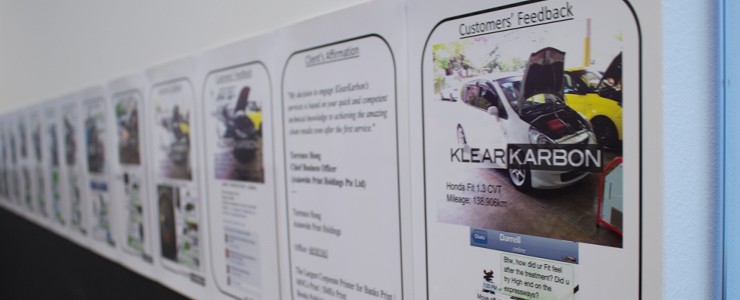
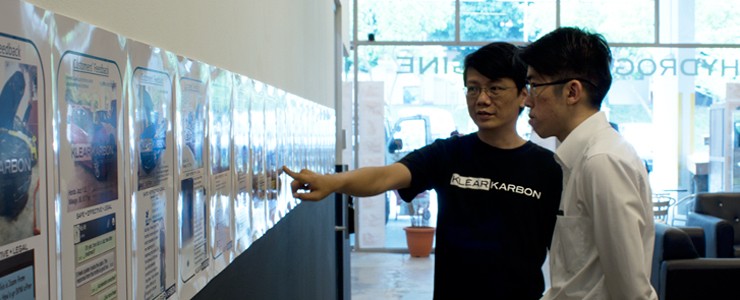
The highlight of the workshop is probably the 'testimonial wall' that features testimonials from owners that have been served by KlearKarbon. Unlike most testimonials that are usually through email or feedback forms, these are screenshots from KlearKarbon's Facebook page and WhatsApp instant messaging service.
 KlearKarbon might be a new startup but the accolades earned span the width of their workshop wallIt is in our nature to be reluctant to try anything new. But with a personal testimonial from us, and countless others, you can be assured this is as authentic as it could get.
For example Adam who drives a Nissan Teana 2.0-litre had this to say, "How come this hydrogen cleaning also makes the engine quieter and reduces vibrations? After the Hydrogen cleaning service I forgot to turn off the engine (twice) because it was too quiet. Thanks Jason and Ken!"
Saving Gaia - One car at a time
Through 'de-karbonizing' the engine, KlearKarbon aims to reduce the carbon footprint of Singapore and clean up the environment in the process - one car at a time. KlearKarbon is not your usual workshop which features spilled oil, car jacks, and tools lying around.
Instead KlearKarbon has four machines the size of a home theatre system subwoofer on a trolley, some hoses, a small indoor water fountain and a wall mounted television surrounded by comfortable couches.
Testimonials
The highlight of the workshop is probably the 'testimonial wall' that features testimonials from owners that have been served by KlearKarbon. Unlike most testimonials that are usually through email or feedback forms, these are screenshots from KlearKarbon's Facebook page and WhatsApp instant messaging service.
For example Adam who drives a Nissan Teana 2.0-litre had this to say, "How come this hydrogen cleaning also makes the engine quieter and reduces vibrations? After the Hydrogen cleaning service I forgot to turn off the engine (twice) because it was too quiet. Thanks Jason and Ken!"
KlearKarbon looks to the future
Having started only in mid-November 2012, the current workshop at Serangoon which can cater to three cars at a given time is sufficient to meet current demand and expect to open another outlet in the western region to serve customers there.
Prior to expansion plans, Jason and Ken would like to spread awareness of the technology. As operating the machine is relatively easy (it's just like turning on a washing machine) product training and employment is relatively simple too, thus manpower crunch in the future should be easily solved.
Hydrogen cleaning costs
KlearKarbon charges in relevance to the engine capacity and dosage of hydrogen gas. The logic is the bigger the engine the more time and machines are used to optimise cleaning. KlearKarbon can de-tox any engine from a class 2b motorcycle to 6500 cubic centimetres (cc).
 As the treatment time takes mere hours, relax and get cosy in this flush, well furnished waiting area with access to amenities like hot drinks or entertainmentThe time taken also varies with the displacement and number of machines yet Jason claims the process should take between 30 to 40 minutes max while a really large engine like a V12 Ferrari perhaps might take up to 40 minutes.
Cars that have clocked more than 100,000km in mileage are highly recommended to take a double dosage treatment for maximum clearance of carbon.
The treatment takes up to 80 minutes, which might sound lengthy but is still faster than usual engine overhauls which can take days, total disassembly and not to mention a dent in your wallet.
As a guide, it costs $108, for a car with an engine capacity of below 2,000 cc with the machine run at 30 minutes. For an average sized sedan that is serviced regularly, one dosage of hydrogen air is good to clear most of the carbon in the engine.
Conclusion
To be honest we were first sceptical of hydrogen cleaning.
Having started only in mid-November 2012, the current workshop at Serangoon which can cater to three cars at a given time is sufficient to meet current demand and expect to open another outlet in the western region to serve customers there.
Prior to expansion plans, Jason and Ken would like to spread awareness of the technology. As operating the machine is relatively easy (it's just like turning on a washing machine) product training and employment is relatively simple too, thus manpower crunch in the future should be easily solved.
Hydrogen cleaning costs
KlearKarbon charges in relevance to the engine capacity and dosage of hydrogen gas. The logic is the bigger the engine the more time and machines are used to optimise cleaning. KlearKarbon can de-tox any engine from a class 2b motorcycle to 6500 cubic centimetres (cc).
Cars that have clocked more than 100,000km in mileage are highly recommended to take a double dosage treatment for maximum clearance of carbon.
The treatment takes up to 80 minutes, which might sound lengthy but is still faster than usual engine overhauls which can take days, total disassembly and not to mention a dent in your wallet.
As a guide, it costs $108, for a car with an engine capacity of below 2,000 cc with the machine run at 30 minutes. For an average sized sedan that is serviced regularly, one dosage of hydrogen air is good to clear most of the carbon in the engine.
Conclusion
To be honest we were first sceptical of hydrogen cleaning.
It sounded too good to be true when Jason and Ken explained how attaching a hose to your engine and pumping it with enough hydrogen would give you similar results to a proper engine overhaul service that takes days and costs a good four-figure sum.
Yet when we tried it on our company vehicle – a Suzuki Every with a small 600cc engine we could feel the difference - instantly.
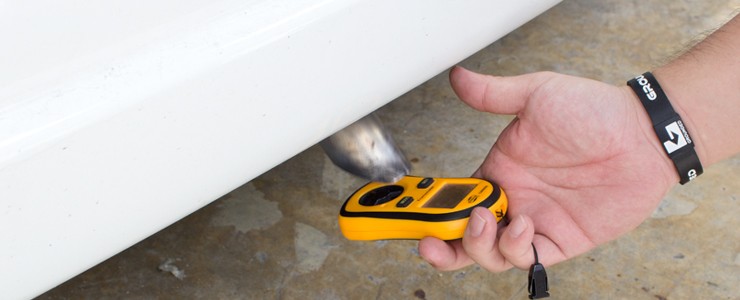
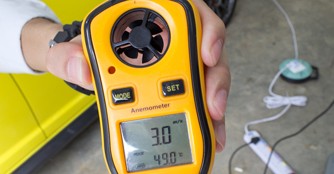 Clearly, the results speak for themselves - the air output clearly increased and handling felt less sluggishPost treatment from KlearKarbon, the pick-up was evidently
smoother, there were less vibrations and the air output from the exhaust increased from 1.6m/s to 3.0m/s - a 87.5 percent increase!
If we could feel a difference on our four-year old Every, we are certain you could feel a better response on mainstream cars.
When speaking to Jason and Ken, they also revealed most customers whom have turbo charged cars embrace hydrogen cleaning as it substantially reduces turbo lag and the initial pick up is smoother.
This is because prior to the turbo building up to a positive pressure, the car had to depend on the power solely from the engine.
The engine runs on a lower compression ratio as compared to naturally aspirated cars, thus post-hydrogen treatment, the engine is met with a cleaner combustion chamber which calls for a reduced turbo lag and improved initial pick up.
For more genuine feedbacks and reviews, you can visit its website at www.klearkarbon.com or their Facebook page. Alternatively, you can call KlearKarbon at 6702 2847.
Location and Operating Hours
25 Kaki Bukit Road 4 #03-66 Synergy @ KB S(417800)
KlearKarbon is open from 10:00am to 7:00pm from Mondays to Saturdays and from 10:00am to 4:00pm on Sundays. It is closed on Public Holidays.
Yet when we tried it on our company vehicle – a Suzuki Every with a small 600cc engine we could feel the difference - instantly.
smoother, there were less vibrations and the air output from the exhaust increased from 1.6m/s to 3.0m/s - a 87.5 percent increase!
If we could feel a difference on our four-year old Every, we are certain you could feel a better response on mainstream cars.
When speaking to Jason and Ken, they also revealed most customers whom have turbo charged cars embrace hydrogen cleaning as it substantially reduces turbo lag and the initial pick up is smoother.
This is because prior to the turbo building up to a positive pressure, the car had to depend on the power solely from the engine.
The engine runs on a lower compression ratio as compared to naturally aspirated cars, thus post-hydrogen treatment, the engine is met with a cleaner combustion chamber which calls for a reduced turbo lag and improved initial pick up.
For more genuine feedbacks and reviews, you can visit its website at www.klearkarbon.com or their Facebook page. Alternatively, you can call KlearKarbon at 6702 2847.
Location and Operating Hours
25 Kaki Bukit Road 4 #03-66 Synergy @ KB S(417800)
KlearKarbon is open from 10:00am to 7:00pm from Mondays to Saturdays and from 10:00am to 4:00pm on Sundays. It is closed on Public Holidays.