View page in desktop
|
Report error
  •   Apple app store icon
  • Google play store icon
Terms of Service
|
Privacy Policy
|
PDPA
|
Site Map
©2004-2026 Sgcarmart, Singapore. All rights reserved.
  • Home
  • Car Articles
  • advice
  • advice Listings
  • Car Technical Advice

Understanding your car tyre

01 Sep 2007

|

40,562 views

With ample types of tyres and brands available in the market, it's vital for drivers to better understand what tyres suit their cars best.

How a tyre is made

Tyre production is a complex technical process which requires stringent monitoring and quality control. This process consists of several manufacturing stages as stated below.
•Mixing
Based on the required performance parameters, a specific composition is created to produce the most suitable tyre. Various grades of natural and synthetic rubber are blended together and mixed with carbon black and other chemical products.
• Calendering
Textile fabric such as nylon, rayon and polyester are used for the casing and cap plies while steel cords are used for the belts. Both are coated with a film of rubber on both sides in the calendering process.
•Tread and Sidewall Extrusion
The mixture of rubber is fed into an extruder which will produce continuous lengths of tread rubber. The rubber will be cut to specific lengths.
•Bead Construction
For each particular tyre, steel wires are wounded on a bead former to become a bead core. The number of turns the steel wires are wounded will determine the diameter and strength for the tyre.
•Tyre Building
The inner liner, body plies and sidewalls are placed on a building drum. The ply edges are wrapped around the bead core; the sidewalls are then moved into position. The tyre is shaped by inflation with two belts afterwhich a cap ply and treads are added.
•Curing
The intermediate product is placed in a mould and cured in a curing press for a specific length of time, pressure and temperature. Once cured, the tyre is ejected from the mould.
•Trimming
Excess rubber is trimmed from the cured tyre mechanically.
•Inspection
Every tyre upon completion will be inspected visually and electronically to ensure uniformity and quality. Once checked, it will be sent for dispatch to be sold in the market.

Tread Patterns and Characteristics

Tread PatternAdvantagesDisadvantagesUsed for
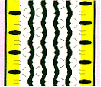
Rib shape:

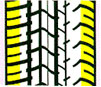
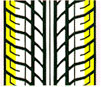
Patterns dominated by multiple circumferential grooves
•Lower rolling resistance
•Good steering control
•Good directional stability
•Poor braking grip on wet roads
•Poor acceleration grip on wet roads
•Sustaining high speeds on paved road surfaces
•Truck or bus steer axles
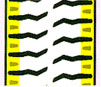
Lug shape:

Patterns with the groove arrangement perpendicular to the circumference of the tyre
•Excellent braking power and traction
•Tendency towards high noise when driven at high speed due to their high rolling resistance
•Dirt roads
•Rear wheels of buses, industrial vehicles and dump
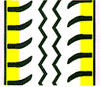
Rib-Lug shape:

Combination of Rib and Lug
•Rib in the centre providing directional control
•Lug at the sides gives good braking & driving power
 
•Paved and dirt roads
•Front & rear wheels of trucks and buses
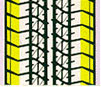
Block-shape:

Patterns consisting of independent blocks divided by circumferential and lateral grooves.
•Good steering control and stability on snow covered and wet roads
•Good water dispersal properties
•Tread blocks are smaller, tyre wear tends to be heavy
•Winter use
•All-season passenger car tyres
•Rear wheel use in ordinary applications
Asymmetric:

Patterns differ on either side of the tyre.
•Optimize the opposing requirements of dry grip and water dispersal
•Must be positioned in the right way to be effective
•High speed cornering due to greater contact area which helps reduce tread wear on the outside of tyre
•High performance and motor sport tyres
Directional pattern:

Lateral grooves on both sides of the tyre which point in the same direction.
•Good driving force
•Good braking performance
•Good water dispersal - stability on wet roads
•Mounted in the direction of the tread pattern to be effective
•Passenger car tyre for high speed use

Markings on a tyre

On every tyre, you will be able to see some standard marking which describes the properties of the tyre. The markings include brand and model name of the tyre, tyre size, tyre aspect ratio, construction type, size of rim, loading rating and speed rating. A common string of numbers and letters can be seen on all tyres that look like this; 225/50 R 16 92V. A tread wear indicator is normally found on a tyre which indicate when you should change your tyre.

Brand and Model Name
This states the brand and model name for the specific tyre. The model name will differ with different tread patterns and functions.

Tyre Size
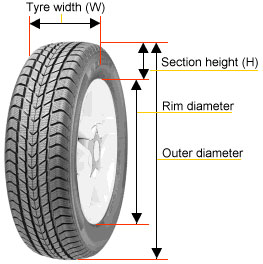
The first set of digits in the string of numbers and letters represent the tyre size. As shown in the example above, the first 3 digits represent the width of the tyre in millimeters.

Aspect Ratio
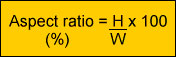
The next pair of digits represents the sidewall aspect ratio. This is the ratio of the tyre's width to its height. 50 in this case mean that the tyre has a height that is equal to 50% of its width. Tyres with an aspect ratio of 50 and below are referred to as low profile tyres.

Construction Type
The letter that follows (normally an R) represents the construction type of the tyre. R represents radial construction which is the most common type seen for passenger cars nowadays.

Loading Rating
The loading rating, also known as the load-index figure, is imprinted on the sidewall of the tyre. It denotes the maximum load capacity of a tyre when driven at maximum speed. A list of load indices (Li) and maximum weights (kg) is give below:

Li

kg

Li

kg

65

290

94

670

66

300

95

690

67

307

96

710

68

315

97

730

69

325

98

750

70

335

99

775

71

345

100

800

72

355

101

825

73

365

102

850

74

375

103

875

75

387

104

900

76

400

105

925

77

412

106

950

78

425

107

975

79

237

108

1000

80

450

109

1030

81

462

110

1060

82

475

111

1090

83

487

112

1120

84

500

113

1150

85

515

114

1180

86

530

115

1215

87

545

116

1250

88

560

117

1285

89

580

118

1320

90

600

119

1360

91

615


92

630


93

650


Speed Rating

Speed symbol

Maximum speed (km/h)

mph

N

140

87

P

150

93

Q

160

99

R

170

106

S

180

112

T

190

118

H

210

130

V

240

149

W

270

168

Y

300

186


Speed category

Maximum speed km/h

mph

ZR

>240

>149


Tread Wear Indicator
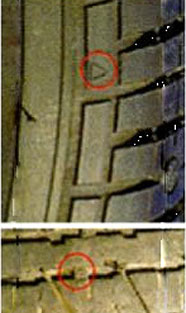
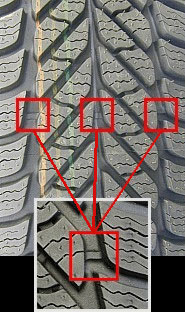
The tread wear indicator can normally be found on the shoulder or upper sidewall part of the tyres. They are normally located in the grooves, evenly spaced out over the tyre. These markers on the tyre will indicate the age of the tyre.

As you use the tyre more often, the tread pattern will eventually become flush with the remainder of the tread. This is a sign to change your tyre. The lack of tread depth implies poor control of the vehicle and may cause an accident.

Related Articles

•Selecting the right tyre and wheel size
•All about tyre balancing
AllReviewsNewsAdviceFeaturesVideos
  • Home
  • Car Articles
  • advice
  • advice Listings
  • Car Technical Advice

Understanding your car tyre

01 Sep 2007

|

40,562 views

With ample types of tyres and brands available in the market, it's vital for drivers to better understand what tyres suit their cars best.

How a tyre is made

Tyre production is a complex technical process which requires stringent monitoring and quality control. This process consists of several manufacturing stages as stated below.
•Mixing
Based on the required performance parameters, a specific composition is created to produce the most suitable tyre. Various grades of natural and synthetic rubber are blended together and mixed with carbon black and other chemical products.
• Calendering
Textile fabric such as nylon, rayon and polyester are used for the casing and cap plies while steel cords are used for the belts. Both are coated with a film of rubber on both sides in the calendering process.
•Tread and Sidewall Extrusion
The mixture of rubber is fed into an extruder which will produce continuous lengths of tread rubber. The rubber will be cut to specific lengths.
•Bead Construction
For each particular tyre, steel wires are wounded on a bead former to become a bead core. The number of turns the steel wires are wounded will determine the diameter and strength for the tyre.
•Tyre Building
The inner liner, body plies and sidewalls are placed on a building drum. The ply edges are wrapped around the bead core; the sidewalls are then moved into position. The tyre is shaped by inflation with two belts afterwhich a cap ply and treads are added.
•Curing
The intermediate product is placed in a mould and cured in a curing press for a specific length of time, pressure and temperature. Once cured, the tyre is ejected from the mould.
•Trimming
Excess rubber is trimmed from the cured tyre mechanically.
•Inspection
Every tyre upon completion will be inspected visually and electronically to ensure uniformity and quality. Once checked, it will be sent for dispatch to be sold in the market.

Tread Patterns and Characteristics

Tread PatternAdvantagesDisadvantagesUsed for
Rib shape:

Patterns dominated by multiple circumferential grooves
•Lower rolling resistance
•Good steering control
•Good directional stability
•Poor braking grip on wet roads
•Poor acceleration grip on wet roads
•Sustaining high speeds on paved road surfaces
•Truck or bus steer axles
Lug shape:

Patterns with the groove arrangement perpendicular to the circumference of the tyre
•Excellent braking power and traction
•Tendency towards high noise when driven at high speed due to their high rolling resistance
•Dirt roads
•Rear wheels of buses, industrial vehicles and dump
Rib-Lug shape:

Combination of Rib and Lug
•Rib in the centre providing directional control
•Lug at the sides gives good braking & driving power
 
•Paved and dirt roads
•Front & rear wheels of trucks and buses
Block-shape:

Patterns consisting of independent blocks divided by circumferential and lateral grooves.
•Good steering control and stability on snow covered and wet roads
•Good water dispersal properties
•Tread blocks are smaller, tyre wear tends to be heavy
•Winter use
•All-season passenger car tyres
•Rear wheel use in ordinary applications
Asymmetric:

Patterns differ on either side of the tyre.
•Optimize the opposing requirements of dry grip and water dispersal
•Must be positioned in the right way to be effective
•High speed cornering due to greater contact area which helps reduce tread wear on the outside of tyre
•High performance and motor sport tyres
Directional pattern:

Lateral grooves on both sides of the tyre which point in the same direction.
•Good driving force
•Good braking performance
•Good water dispersal - stability on wet roads
•Mounted in the direction of the tread pattern to be effective
•Passenger car tyre for high speed use

Markings on a tyre

On every tyre, you will be able to see some standard marking which describes the properties of the tyre. The markings include brand and model name of the tyre, tyre size, tyre aspect ratio, construction type, size of rim, loading rating and speed rating. A common string of numbers and letters can be seen on all tyres that look like this; 225/50 R 16 92V. A tread wear indicator is normally found on a tyre which indicate when you should change your tyre.

Brand and Model Name
This states the brand and model name for the specific tyre. The model name will differ with different tread patterns and functions.

Tyre Size
The first set of digits in the string of numbers and letters represent the tyre size. As shown in the example above, the first 3 digits represent the width of the tyre in millimeters.

Aspect Ratio
The next pair of digits represents the sidewall aspect ratio. This is the ratio of the tyre's width to its height. 50 in this case mean that the tyre has a height that is equal to 50% of its width. Tyres with an aspect ratio of 50 and below are referred to as low profile tyres.


Construction Type
The letter that follows (normally an R) represents the construction type of the tyre. R represents radial construction which is the most common type seen for passenger cars nowadays.

Loading Rating
The loading rating, also known as the load-index figure, is imprinted on the sidewall of the tyre. It denotes the maximum load capacity of a tyre when driven at maximum speed. A list of load indices (Li) and maximum weights (kg) is give below:

Li

kg

Li

kg

65

290

94

670

66

300

95

690

67

307

96

710

68

315

97

730

69

325

98

750

70

335

99

775

71

345

100

800

72

355

101

825

73

365

102

850

74

375

103

875

75

387

104

900

76

400

105

925

77

412

106

950

78

425

107

975

79

237

108

1000

80

450

109

1030

81

462

110

1060

82

475

111

1090

83

487

112

1120

84

500

113

1150

85

515

114

1180

86

530

115

1215

87

545

116

1250

88

560

117

1285

89

580

118

1320

90

600

119

1360

91

615


92

630


93

650


Speed Rating

Speed symbol

Maximum speed (km/h)

mph

N

140

87

P

150

93

Q

160

99

R

170

106

S

180

112

T

190

118

H

210

130

V

240

149

W

270

168

Y

300

186


Speed category

Maximum speed km/h

mph

ZR

>240

>149


Tread Wear Indicator
The tread wear indicator can normally be found on the shoulder or upper sidewall part of the tyres. They are normally located in the grooves, evenly spaced out over the tyre. These markers on the tyre will indicate the age of the tyre.

As you use the tyre more often, the tread pattern will eventually become flush with the remainder of the tread. This is a sign to change your tyre. The lack of tread depth implies poor control of the vehicle and may cause an accident.


Related Articles

•Selecting the right tyre and wheel size
•All about tyre balancing
Jegan Das Haridas
Text and photos by Jegan Das Haridas
Writing may be my thing, but cars, well, that's just pure passion that I simply cannot get rid off.
24.4k

Tags

understanding car tyre car tyre tyre of a car understanding tyre of a car tyre

Jegan Das Haridas
Text and photos by Jegan Das Haridas
Writing may be my thing, but cars, well, that's just pure passion that I simply cannot get rid off.
24.4k

Tags

understanding car tyre car tyre tyre of a car understanding tyre of a car tyre

All Advice Categories

Car BuyingCar SellingCar OwnershipCar TechnicalCar MaintenanceMiscellaneous

All Advice Categories

Car BuyingCar SellingCar OwnershipCar TechnicalCar MaintenanceMiscellaneous

Related Motor Directory Categories

    Power EnhancementBodykits & PartsRacing & Motorsports EquipmentAccident Repair & ClaimsHandling & Safety

Related Motor Directory Categories

    Power EnhancementBodykits & PartsRacing & Motorsports EquipmentAccident Repair & ClaimsHandling & Safety

You May Also Like

Sgcarmart Explores: Bras Basah!

Sgcarmart Explores: Bras Basah!

New cars are safer: Opt for one when you can

New cars are safer: Opt for one when you can

Maxus MIFA 7 Elite: Going big for the little moments

Maxus MIFA 7 Elite: Going big for the little moments

The BYD Sealion 8 seven-seater SUV arrives in Singapore

The BYD Sealion 8 seven-seater SUV arrives in Singapore

The all new XPENG Mona L03 is one smart coupe SUV

The all new XPENG Mona L03 is one smart coupe SUV

Sgcarmart Explores: East Coast Park!

Sgcarmart Explores: East Coast Park!

Opinion: Why do we even need green number plates?

Opinion: Why do we even need green number plates?

Is parallel import hesitancy growing among car buyers?

Is parallel import hesitancy growing among car buyers?

Don't get yourself trapped in your high-tech EV

Don't get yourself trapped in your high-tech EV

Must-Have Car Accessories Every EV Driver Should Own

Must-Have Car Accessories Every EV Driver Should Own

Hongqi Singapore opens its showroom doors

Hongqi Singapore opens its showroom doors

Ferrari 849 Testarossa Spider - with the sky included

Ferrari 849 Testarossa Spider - with the sky included

The rise of PHEVs: A closer look at the numbers

The rise of PHEVs: A closer look at the numbers

Mercedes-Benz GLB250+ Review

Mercedes-Benz GLB250+ Review

Tesla launches Model Y L in Singapore, first six-seater here

Tesla launches Model Y L in Singapore, first six-seater here

5 trends to look out for in 2026

5 trends to look out for in 2026

You May Also Like

Sgcarmart Explores: Bras Basah!

Sgcarmart Explores: Bras Basah!

New cars are safer: Opt for one when you can

New cars are safer: Opt for one when you can

Maxus MIFA 7 Elite: Going big for the little moments

Maxus MIFA 7 Elite: Going big for the little moments

The BYD Sealion 8 seven-seater SUV arrives in Singapore

The BYD Sealion 8 seven-seater SUV arrives in Singapore

The all new XPENG Mona L03 is one smart coupe SUV

The all new XPENG Mona L03 is one smart coupe SUV

Sgcarmart Explores: East Coast Park!

Sgcarmart Explores: East Coast Park!

Opinion: Why do we even need green number plates?

Opinion: Why do we even need green number plates?

Is parallel import hesitancy growing among car buyers?

Is parallel import hesitancy growing among car buyers?

Don't get yourself trapped in your high-tech EV

Don't get yourself trapped in your high-tech EV

Must-Have Car Accessories Every EV Driver Should Own

Must-Have Car Accessories Every EV Driver Should Own

Hongqi Singapore opens its showroom doors

Hongqi Singapore opens its showroom doors

Ferrari 849 Testarossa Spider - with the sky included

Ferrari 849 Testarossa Spider - with the sky included

The rise of PHEVs: A closer look at the numbers

The rise of PHEVs: A closer look at the numbers

Mercedes-Benz GLB250+ Review

Mercedes-Benz GLB250+ Review

Tesla launches Model Y L in Singapore, first six-seater here

Tesla launches Model Y L in Singapore, first six-seater here

5 trends to look out for in 2026

5 trends to look out for in 2026

Related Articles

Is parallel import hesitancy growing among car buyers?

Is parallel import hesitancy growing among car buyers?

Opinion: Why do we even need green number plates?

Opinion: Why do we even need green number plates?

The rise of PHEVs: A closer look at the numbers

The rise of PHEVs: A closer look at the numbers

Sgcarmart Explores: East Coast Park!

Sgcarmart Explores: East Coast Park!

MG 4 Urban Review

MG 4 Urban Review

Jaecoo 8 Plug-in Hybrid Review

Jaecoo 8 Plug-in Hybrid Review

Sgcarmart Explores: Bras Basah!

Sgcarmart Explores: Bras Basah!

All-electric Mazda6e fastback unveiled at SG Motor Show 2026

All-electric Mazda6e fastback unveiled at SG Motor Show 2026

Related Articles

Is parallel import hesitancy growing among car buyers?

Is parallel import hesitancy growing among car buyers?

Opinion: Why do we even need green number plates?

Opinion: Why do we even need green number plates?

The rise of PHEVs: A closer look at the numbers

The rise of PHEVs: A closer look at the numbers

Sgcarmart Explores: East Coast Park!

Sgcarmart Explores: East Coast Park!

MG 4 Urban Review

MG 4 Urban Review

Jaecoo 8 Plug-in Hybrid Review

Jaecoo 8 Plug-in Hybrid Review

Sgcarmart Explores: Bras Basah!

Sgcarmart Explores: Bras Basah!

All-electric Mazda6e fastback unveiled at SG Motor Show 2026

All-electric Mazda6e fastback unveiled at SG Motor Show 2026