Audi wants to further improve its employees' ergonomics in its production facilities. For this reason, the company is currently conducting a comparative study of two exoskeletons.
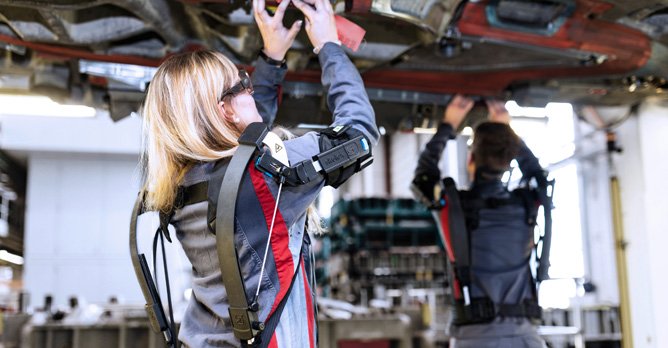

These external support structures are designed to help employees when they are performing overhead tasks by protecting their joints and tiring their muscles less quickly.
All in all, around 60 employees are currently using the exoskeletons over a period of several weeks at selected workstations in assembly, at the paint shop, and at tool construction at the Ingolstadt site.
Both the Paexo and the Skelex 360 are worn like a backpack on the shoulders and secured in place with a belt around the hips. Arm shells support the arms when the wearer is performing overhead work. These absorb part of the arm's weight and re‑direct it to the hips via support structures. This reduces the burden on the shoulders. This is done purely mechanically, without any motorised assistance.