By the time a spacecraft leaves the last layer of Earth's atmosphere, it no longer needs to be streamlined, because out in space there is very little air to provide any resistance. In fact, there are so few air molecules way 'up there' that even the sun's rays have nothing to reflect off - which is why outer space, as we know it, perpetually appears to be night.
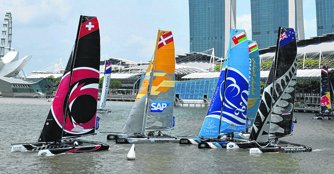
 The power of air in motion can be illustrated by how wind can propel sail boatsThe air down here on Planet Earth consists predominantly of nitrogen and oxygen, with an average density of 1.2kg per cubic metre. That's enough to reflect light and, yes, enough to create 'buoyancy' for aeroplanes to fly on. It's also enough to
impede motion - an effect better known as aerodynamic resistance.
Air-ssentials
Air, like any gas or liquid, is technically classified as a fluid because it can flow over, below or around a solid object. In
extreme conditions, fast-moving air (or a 'full-blown' wind) can exert a tremendous force. That it can propel a sailboat illustrates the power of air in motion.
Wind resistance and the behaviour of air around a moving car are critical aspects of automotive design, because they affect fuel economy, driving stability and cruising refinement. Motor vehicles, of course, travel on terra firma, but they still have to move through air. Any object moving along is opposing forces exerted by air, which increase as the speed of movement rises.
impede motion - an effect better known as aerodynamic resistance.
Air-ssentials
Air, like any gas or liquid, is technically classified as a fluid because it can flow over, below or around a solid object. In
extreme conditions, fast-moving air (or a 'full-blown' wind) can exert a tremendous force. That it can propel a sailboat illustrates the power of air in motion.
Wind resistance and the behaviour of air around a moving car are critical aspects of automotive design, because they affect fuel economy, driving stability and cruising refinement. Motor vehicles, of course, travel on terra firma, but they still have to move through air. Any object moving along is opposing forces exerted by air, which increase as the speed of movement rises.
The laws of physics have defined the drag (or resistance) due to air to be proportional to the square of the speed. What this means is that if the speed is doubled, drag increases by four times (i.e. 2 x 2), and if speed is tripled, drag increases by a factor of nine (i.e. 3 x 3), and so on. Drag consumes kinetic energy and compromises the car's efficiency.
Air-bracadabra
There are still plenty of unknowns that surround the scientific analysis of moving air. The underlying reason is that air, though gaseous in state, is nonetheless a fluid. In its worst form, such as a hurricane or a tornado, moving air has enough power to uproot trees and devastate buildings. Even today, the physical predictability of wind remains a dark science.
 Moving air has enough power to uproot trees and destruct buildingsThere are very few 'magicians' who know exactly how air behaves (or misbehaves) over a moving object, and they are somehow able to manipulate said behaviour. One of them is Adrian Newey, Red Bull F1's chief engineer and possibly
the world's top automotive aerodynamicist.
That Newey's scalp is devoid of any turbulence-inducing hair might not be a mere coincidence!
Air-bracadabra
There are still plenty of unknowns that surround the scientific analysis of moving air. The underlying reason is that air, though gaseous in state, is nonetheless a fluid. In its worst form, such as a hurricane or a tornado, moving air has enough power to uproot trees and devastate buildings. Even today, the physical predictability of wind remains a dark science.
the world's top automotive aerodynamicist.
That Newey's scalp is devoid of any turbulence-inducing hair might not be a mere coincidence!
Air-fficiency
A smooth, uninterrupted surface is practically impossible to achieve with a vehicle body because of the need for ventilation apertures, windscreens, windows, wheels and tyres, door handles, door mirrors etc, all of which are culprits of drag.
And cars need to look good, or at least presentable. Seriously, would you drive an egg-on-wheels or an Audi R8? That is the conflict between dynamic styling and aerodynamic efficiency.
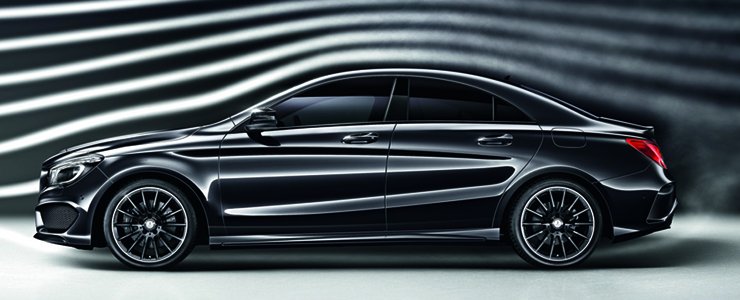
 The CLA-Class has set a new benchmark for coefficient of drag with a drag coefficient (Cd) figure of just 0.22There is yet another aspect of automotive aerodynamics that throws a spanner in the works - 'aerodynamic instability'. While
it's true that a slick, low-drag shape is ideal for cutting cleanly through the air, the aerodynamic forces underneath, overhead
and along the sides of the car give rise to lift, which is destabilising.
It's actually more complicated than that. Everywhere along the airstreams, various changes in characteristics take place, resulting in forces of different magnitude and direction acting at different places on the car. This is what causes instability and drag.
For instance, air that flows over the bonnet and roof increases in velocity, and according to the physics of fluid dynamics, an increase in velocity causes an inverse effect on pressure.
Hence, on the upper surface of the car, there will be less force per unit area than under the car, where the air takes a less deviated route and thus experiences little or no drop in velocity. The nett force acts upwards, causing 'lift'.
At the same time, every surface on the vehicle that protrudes perpendicular to the direction of travel (basically everything you
see head-on in 2-D) is drag-inducing.
A smooth, uninterrupted surface is practically impossible to achieve with a vehicle body because of the need for ventilation apertures, windscreens, windows, wheels and tyres, door handles, door mirrors etc, all of which are culprits of drag.
And cars need to look good, or at least presentable. Seriously, would you drive an egg-on-wheels or an Audi R8? That is the conflict between dynamic styling and aerodynamic efficiency.
it's true that a slick, low-drag shape is ideal for cutting cleanly through the air, the aerodynamic forces underneath, overhead
and along the sides of the car give rise to lift, which is destabilising.
It's actually more complicated than that. Everywhere along the airstreams, various changes in characteristics take place, resulting in forces of different magnitude and direction acting at different places on the car. This is what causes instability and drag.
For instance, air that flows over the bonnet and roof increases in velocity, and according to the physics of fluid dynamics, an increase in velocity causes an inverse effect on pressure.
Hence, on the upper surface of the car, there will be less force per unit area than under the car, where the air takes a less deviated route and thus experiences little or no drop in velocity. The nett force acts upwards, causing 'lift'.
At the same time, every surface on the vehicle that protrudes perpendicular to the direction of travel (basically everything you
see head-on in 2-D) is drag-inducing.
There is no running away from the fact that the various protrusions have a direct effect on drag. In other words, a smaller 'face' and skinnier tyres create less aerodynamic resistance.
Air Command
Major motor manufacturers have spent hundreds of millions on wind-tunnel tests and facilities to develop aerodynamically efficient vehicles. However, in order to alleviate the undesirable effects of moving air on a motorcar, certain compromises to outright aerodynamic efficiency have to be made.
The cleanest car shapes in the business have barely any spoilers or fins - at least none that are visible. They are the result of top-notch wind tunnel work and first-class engineering. Of course, coupes and supercars are much easier for aerodynamicists to 'tune' compared to conventional saloons and SUVs, thanks to the sporty models' lower frontal areas, tapering extremities, and smaller gaps between the undercarriage and the tarmac.
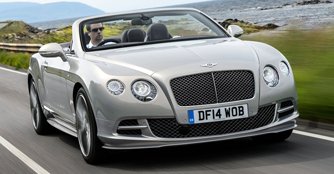 Engineers ensure that passenger compartments are as draught-free as possible so that roof-down motoring in open-top sports cars, such as the Bentley Continental GT Speed Convertible (above), can be enjoyed Regardless of body shape and product type, an automaker that can take command of the air, so to speak, will be able to
optimise both aerodynamic efficiency and overall stability.
Here are some related articles that might interest you
Top 20 cars you can buy now with the lowest dealer mark-up (2020)
What makes cars so expensive in Singapore
These are the 10 cheapest brand new cars you can buy in 2020
What goes into making a quality oil?
6 types of performance modifications to make your car faster on the track
Air Command
Major motor manufacturers have spent hundreds of millions on wind-tunnel tests and facilities to develop aerodynamically efficient vehicles. However, in order to alleviate the undesirable effects of moving air on a motorcar, certain compromises to outright aerodynamic efficiency have to be made.
The cleanest car shapes in the business have barely any spoilers or fins - at least none that are visible. They are the result of top-notch wind tunnel work and first-class engineering. Of course, coupes and supercars are much easier for aerodynamicists to 'tune' compared to conventional saloons and SUVs, thanks to the sporty models' lower frontal areas, tapering extremities, and smaller gaps between the undercarriage and the tarmac.
optimise both aerodynamic efficiency and overall stability.
Here are some related articles that might interest you
Top 20 cars you can buy now with the lowest dealer mark-up (2020)
What makes cars so expensive in Singapore
These are the 10 cheapest brand new cars you can buy in 2020
What goes into making a quality oil?
6 types of performance modifications to make your car faster on the track