View page in desktop
|
Report error
  •   Apple app store icon
  • Google play store icon
Terms of Service
|
Privacy Policy
|
PDPA
|
Site Map
©2004-2026 Sgcarmart, Singapore. All rights reserved.
  • Home
  • Car Articles
  • reviews
  • reviews Listings
  • Hyundai Reviews

Hyundai i30 Review

05 May 2008

|

89,218 views

You might be tired of all those "i"-related names, but ironically, both the iMac and i30 have one thing in common. To further understand what and why, lets start with a lengthy, thousand-odd worded explanation. Getting bored already?


The Hyundai i30 - sister to Kia's Cee'd, is one big, serious attempt to break into the European market. It will also emerge from a new plant in the Czech Republic in addition to the made-in-Korea variant that we will receive.

Positioning

Hyundai wants to separate the i30 from the Cee'd - which tends to cater to the youthful, sportier and budget conscious crowd - something like what Audi is to Volkswagen. However, it has the tough and arduous job of getting rid of the company's 'bargain' image for good.

This brings me to a burning point - many local forums have voiced their dismay over the fact that the i30 is indeed, a very expensive Korean car in the typical Singaporean context.
I agree.

But I also beg to differ. You see, and here's the tough part - Hyundai has actually come up with a product that entirely justifies the sub-$70,000 price tag associated with the i30. The problem, now, is convincing the "typical" Hyundai entourage, and prospective buyers, that this is one such car that sends a rude prod in the direction of Toyota, and some other competitors, to wake up and smell the coffee.

Styling

The Cee'd and i30 are essentially the same under the skin, down to their doors and dashboard templates. Both resemble the mark of a Golf or Focus five-door hatch, while the Hyundai has a cuter, buffed over snout. The elongated rear lights look like that of the Mercedes A-Class, while the flat, recessed boot-line and tailgate screams BMW 1-Series.

A chrome blade across the air intake grille, and a side profile that gives the Mazda 3 and Subaru Impreza a good hiding. It isn't striking, but it exudes handsome charm and little more "spark" compared to anything else in its class.

"Equipped inside"

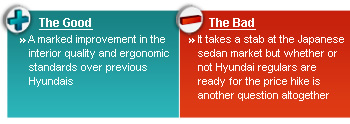
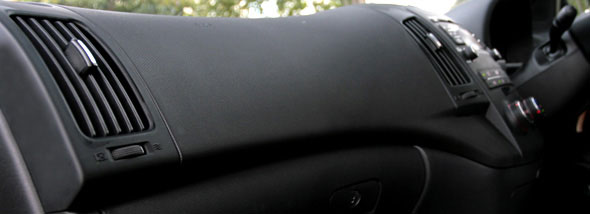
The days of lackluster quality and lack in detail are over. Since the debut of the Getz, Avante, and face-lifted Tuscani, we've seen Hyundai gradually improve their ergonomics. As such, the i30 represents another new level of quality for Hyundai, and this time, it equals or betters every single 1.6-litre Japanese offering.

With a sunroof, leather-wrapped everything, chiller-glove box, iPod connectivity (option), fog lights, trip computer, immobilizer, proper chrome detailing, tactile, soft-to-the-touch materials, curtain airbags, ESP and brake assist - you'd be forgiven for thinking that you've woken up inside a European car.
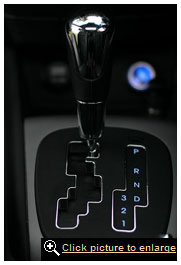
The key has a foldaway blade and built-in boot, remote lock/unlock controls, and bears an uncanny resemblance to that of a Volkswagen Group fob.

The entire interior fits beautifully together, while various opening flaps operate with a smooth, damped action. The cup holders are properly sized (finally) while the upper sections of the doors are covered in high-quality, padded plastic.

Like the Mazda 6 and Honda Accord, the seats feature excellent range adjustability for the typical driver, especially because the steering now adjusts for both tilt and reach. Head, leg and shoulder room is pretty much average with no significant advantage over a Corolla or Civic, but it does match up nicely.

Major criticisms would be that the local market i30 does not come with climate or cruise control. That's sad, considering it has powered windows that wind up and down automatically for ALL doors.

The instrument cluster can be a little hard to read from 6:30pm onwards on a cloudless evening unless you turn the automatic headlamps on, while the blue-and white backlighting visually mismatches the centre console.

The Hyundai receives a four-star rating for occupancy protection - one less than the Cee'd due to an increased risk of leg injury, but it still gets three stars for child protection and two for pedestrian impacts.
The driving experience

Predictably, we only get the 1.6-litre petrol that gives 122bhp at 6,200rpm, and 154Nm at 4,200rpm. The CVVT (continuously variable valve timing) block's design places the extractors aft of the engine.
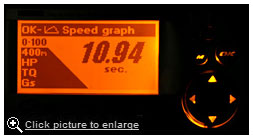
A normal, 0-100km/h sprint happens in 10.94 seconds with a quarter-tank of petrol, and with the air-conditioning turned off. Noteworthy is the fact that the cabin remains as silent as that of a Camry when cruising at speeds of up to 160km/h, sans a little rustling behind its C-pillars. There's very little road noise from the 185/65 R15s, while future i30s will come standard with larger rims and tyres.

Everything remains as solid and unruffled as a Volkswagen Golf - there's a striking amount of suppleness over the fastest, and harshest of humps, partially because it has been set up to be softer than the Cee'd.

The rear end of this car has multi-linked suspension arms instead of the Corolla's meager torsion beam. The steering has enough feel and accuracy to inspire confidence through hard corners and the rain - a good example of an electrically assisted system.

All those controls were as well weighted as I had hoped. The progressive brakes, responsive throttle and steering meant that the car flowed easily when driven hard, regardless of situation.

What really grabs an enthusiastic driver's attention, would be the way the rear end of this car reacts when thrown into the corner. Neutral is hardly a word used to describe Hyundais. Turn the intrusive ESP off. Yes, it does tend to understeer at the limits, but with a little coaxing on the brakes, the rear end predictably steps out a little, just enough to get the nose pointed towards corner exit.

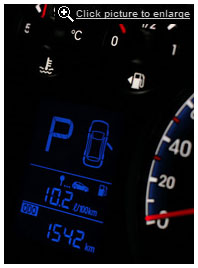
The i30 clocked in a 10km/litre average from a day's worth of hard driving. Very impressive.

Is it worth it?
Hyundai's authorized distributor, Komoco Motors, claims a $5000 (approximate, unconfirmed figure) profit per i30 sold, citing a high initial cost for the actual car.

This means that it costs $6000 less than a 1.6-litre Honda Civic automatic. Then, there's the comparatively inferior, crashy, unrefined but more economical Toyota Corolla that's hardly worth the $68,388 price tag.

A similarly equipped Mazda 3 1.6-litre hatchback might perhaps, be the i30's closest match at around $66,000 (after all those rebates, that is) but even then, it doesn't come with automatic windows, a sunroof, and suffers slightly in terms of space and high speed refinement.

We'll leave you to ponder over that pickle, but do consider that Hyundai has done to the i30 what Apple has done for the iMac - it revolutionized people's perceptions of their products, although no doubt at a premium.

While the i30 should have been priced a little lower in order to let the car-buying audience warm up to it, we can't deny that this car is every bit worth its weight in the $69,999 price tag it carries.

In fact, we'd feel a little sad if the Hyundai i30 doesn't sell as well as any Corolla, Mazda, Civic™ you get the picture.

AllReviewsNewsAdviceFeaturesVideos
  • Home
  • Car Articles
  • reviews
  • reviews Listings
  • Hyundai Reviews

Hyundai i30 Review

05 May 2008

|

89,218 views

You might be tired of all those "i"-related names, but ironically, both the iMac and i30 have one thing in common. To further understand what and why, lets start with a lengthy, thousand-odd worded explanation. Getting bored already?


The Hyundai i30 - sister to Kia's Cee'd, is one big, serious attempt to break into the European market. It will also emerge from a new plant in the Czech Republic in addition to the made-in-Korea variant that we will receive.

Positioning

Hyundai wants to separate the i30 from the Cee'd - which tends to cater to the youthful, sportier and budget conscious crowd - something like what Audi is to Volkswagen. However, it has the tough and arduous job of getting rid of the company's 'bargain' image for good.

This brings me to a burning point - many local forums have voiced their dismay over the fact that the i30 is indeed, a very expensive Korean car in the typical Singaporean context.

I agree.

But I also beg to differ. You see, and here's the tough part - Hyundai has actually come up with a product that entirely justifies the sub-$70,000 price tag associated with the i30. The problem, now, is convincing the "typical" Hyundai entourage, and prospective buyers, that this is one such car that sends a rude prod in the direction of Toyota, and some other competitors, to wake up and smell the coffee.

Styling

The Cee'd and i30 are essentially the same under the skin, down to their doors and dashboard templates. Both resemble the mark of a Golf or Focus five-door hatch, while the Hyundai has a cuter, buffed over snout. The elongated rear lights look like that of the Mercedes A-Class, while the flat, recessed boot-line and tailgate screams BMW 1-Series.

A chrome blade across the air intake grille, and a side profile that gives the Mazda 3 and Subaru Impreza a good hiding. It isn't striking, but it exudes handsome charm and little more "spark" compared to anything else in its class.

"Equipped inside"

The days of lackluster quality and lack in detail are over. Since the debut of the Getz, Avante, and face-lifted Tuscani, we've seen Hyundai gradually improve their ergonomics. As such, the i30 represents another new level of quality for Hyundai, and this time, it equals or betters every single 1.6-litre Japanese offering.

With a sunroof, leather-wrapped everything, chiller-glove box, iPod connectivity (option), fog lights, trip computer, immobilizer, proper chrome detailing, tactile, soft-to-the-touch materials, curtain airbags, ESP and brake assist - you'd be forgiven for thinking that you've woken up inside a European car.

The key has a foldaway blade and built-in boot, remote lock/unlock controls, and bears an uncanny resemblance to that of a Volkswagen Group fob.

The entire interior fits beautifully together, while various opening flaps operate with a smooth, damped action. The cup holders are properly sized (finally) while the upper sections of the doors are covered in high-quality, padded plastic.

Like the Mazda 6 and Honda Accord, the seats feature excellent range adjustability for the typical driver, especially because the steering now adjusts for both tilt and reach. Head, leg and shoulder room is pretty much average with no significant advantage over a Corolla or Civic, but it does match up nicely.

Major criticisms would be that the local market i30 does not come with climate or cruise control. That's sad, considering it has powered windows that wind up and down automatically for ALL doors.

The instrument cluster can be a little hard to read from 6:30pm onwards on a cloudless evening unless you turn the automatic headlamps on, while the blue-and white backlighting visually mismatches the centre console.

The Hyundai receives a four-star rating for occupancy protection - one less than the Cee'd due to an increased risk of leg injury, but it still gets three stars for child protection and two for pedestrian impacts.

The driving experience

Predictably, we only get the 1.6-litre petrol that gives 122bhp at 6,200rpm, and 154Nm at 4,200rpm. The CVVT (continuously variable valve timing) block's design places the extractors aft of the engine.

A normal, 0-100km/h sprint happens in 10.94 seconds with a quarter-tank of petrol, and with the air-conditioning turned off. Noteworthy is the fact that the cabin remains as silent as that of a Camry when cruising at speeds of up to 160km/h, sans a little rustling behind its C-pillars. There's very little road noise from the 185/65 R15s, while future i30s will come standard with larger rims and tyres.

Everything remains as solid and unruffled as a Volkswagen Golf - there's a striking amount of suppleness over the fastest, and harshest of humps, partially because it has been set up to be softer than the Cee'd.

The rear end of this car has multi-linked suspension arms instead of the Corolla's meager torsion beam. The steering has enough feel and accuracy to inspire confidence through hard corners and the rain - a good example of an electrically assisted system.

All those controls were as well weighted as I had hoped. The progressive brakes, responsive throttle and steering meant that the car flowed easily when driven hard, regardless of situation.

What really grabs an enthusiastic driver's attention, would be the way the rear end of this car reacts when thrown into the corner. Neutral is hardly a word used to describe Hyundais. Turn the intrusive ESP off. Yes, it does tend to understeer at the limits, but with a little coaxing on the brakes, the rear end predictably steps out a little, just enough to get the nose pointed towards corner exit.

The i30 clocked in a 10km/litre average from a day's worth of hard driving. Very impressive.

Is it worth it?

Hyundai's authorized distributor, Komoco Motors, claims a $5000 (approximate, unconfirmed figure) profit per i30 sold, citing a high initial cost for the actual car.

This means that it costs $6000 less than a 1.6-litre Honda Civic automatic. Then, there's the comparatively inferior, crashy, unrefined but more economical Toyota Corolla that's hardly worth the $68,388 price tag.

A similarly equipped Mazda 3 1.6-litre hatchback might perhaps, be the i30's closest match at around $66,000 (after all those rebates, that is) but even then, it doesn't come with automatic windows, a sunroof, and suffers slightly in terms of space and high speed refinement.

We'll leave you to ponder over that pickle, but do consider that Hyundai has done to the i30 what Apple has done for the iMac - it revolutionized people's perceptions of their products, although no doubt at a premium.

While the i30 should have been priced a little lower in order to let the car-buying audience warm up to it, we can't deny that this car is every bit worth its weight in the $69,999 price tag it carries.

In fact, we'd feel a little sad if the Hyundai i30 doesn't sell as well as any Corolla, Mazda, Civic™ you get the picture.

Amery Reuben
Text and photos by Amery Reuben
Writing may be my thing, but cars, well, that's just pure passion that I simply cannot get rid off.
24.4k

Tags

hyundai hyundai i30 i30 korean car hatchback

Amery Reuben
Text and photos by Amery Reuben
Writing may be my thing, but cars, well, that's just pure passion that I simply cannot get rid off.
24.4k

Tags

hyundai hyundai i30 i30 korean car hatchback

Car Information

Hyundai i30 1.6 GLS 5dr Sunroof (A)

3.5/5

CAT A | Petrol | 14.5km/L

Horsepower

91kW (122 bhp)

Torque

154 Nm

Acceleration

10.9sec (0-100km /hr)

This model is no longer being sold by local distributor
All Used Hyundai i30
Newsletter

Be Notified On The Latest News

Car Information

Hyundai i30 1.6 GLS 5dr Sunroof (A)

3.5/5

CAT A | Petrol | 14.5km/L

Horsepower

91kW (122 bhp)

Torque

154 Nm

Acceleration

10.9sec (0-100km /hr)

This model is no longer being sold by local distributor
All Used Hyundai i30
Newsletter

Be Notified On The Latest News

You May Also Like

Get your next rental from AKA Car Rental

Get your next rental from AKA Car Rental

New to driving? Here's how to become a better driver

New to driving? Here's how to become a better driver

Sgcarmart Explores: 2026 National Day Edition!

Sgcarmart Explores: 2026 National Day Edition!

Dunlop's new tyres for an electrified world

Dunlop's new tyres for an electrified world

Corvette Stingray Review

Corvette Stingray Review

Omoda & Jaecoo is forging ahead with its Super AI cockpit

Omoda & Jaecoo is forging ahead with its Super AI cockpit

A first look at the Sitrak Light eTruck!

A first look at the Sitrak Light eTruck!

The new Pirelli Cinturato Rosso with Seal Inside Tech!

The new Pirelli Cinturato Rosso with Seal Inside Tech!

You May Also Like

Get your next rental from AKA Car Rental

Get your next rental from AKA Car Rental

New to driving? Here's how to become a better driver

New to driving? Here's how to become a better driver

Sgcarmart Explores: 2026 National Day Edition!

Sgcarmart Explores: 2026 National Day Edition!

Dunlop's new tyres for an electrified world

Dunlop's new tyres for an electrified world

Corvette Stingray Review

Corvette Stingray Review

Omoda & Jaecoo is forging ahead with its Super AI cockpit

Omoda & Jaecoo is forging ahead with its Super AI cockpit

A first look at the Sitrak Light eTruck!

A first look at the Sitrak Light eTruck!

The new Pirelli Cinturato Rosso with Seal Inside Tech!

The new Pirelli Cinturato Rosso with Seal Inside Tech!

Related Articles

Hyundai Ioniq 9 Calligraphy 6-Seater Review

Hyundai Ioniq 9 Calligraphy 6-Seater Review

Hyundai wants its EVs to power homes and the grid

Hyundai wants its EVs to power homes and the grid

Hyundai adds Black Ink trim to Palisade Hybrid

Hyundai adds Black Ink trim to Palisade Hybrid

Hyundai presents first Hyundai Blue Prize+ 2025 exhibition

Hyundai presents first Hyundai Blue Prize+ 2025 exhibition

Hyundai brought the all-new Ioniq 3 to the Goodwood Festival

Hyundai brought the all-new Ioniq 3 to the Goodwood Festival

Related Articles

Hyundai Ioniq 9 Calligraphy 6-Seater Review

Hyundai Ioniq 9 Calligraphy 6-Seater Review

Hyundai wants its EVs to power homes and the grid

Hyundai wants its EVs to power homes and the grid

Hyundai adds Black Ink trim to Palisade Hybrid

Hyundai adds Black Ink trim to Palisade Hybrid

Hyundai presents first Hyundai Blue Prize+ 2025 exhibition

Hyundai presents first Hyundai Blue Prize+ 2025 exhibition

Hyundai brought the all-new Ioniq 3 to the Goodwood Festival

Hyundai brought the all-new Ioniq 3 to the Goodwood Festival