Mazda's new flagship model has been highly acclaimed worldwide for its new technology and performance that redefine the executive sedan segment. Despite having already tested the car, there were still some questions left unanswered.
Mr. Hiroshi Kajiyama (HK), Program Manager for the Mazda6, recently stopped over in Singapore for a visit. And we reckon there wasn't a better time to unravel some of our queries.
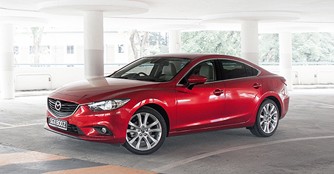

We get up close and personal with Mr. Hiroshi Kajiyama to find out what else is there to the Mazda6 other than just the current variants and body type.
SGCM: The latest Mazda6 is no doubt a huge step forward from its predecessor in terms of styling and technology. The SkyActiv technology, for instance, was also implemented in the CX-5. Were there any differences from that as compared to the Mazda6?
HK: The transmission and engine found in the Mazda6 are the same as the CX-5. But of course we added more things to the Mazda6. For example, we tweaked the accelerator system that detects the speed of the Mazda6, which allows easy adjustments to the engine and the transmission, to suit the car.

SGCM: Are we expecting any other variants of the Mazda6 in time to come? Perhaps a performance variant such as the MPS or even a coupe?
HK: At this moment, it's very difficult to specify what kind of version is coming to the market. Still, we can confidently say that we are taking into consideration all the different kinds of version of the Mazda6.
As a Program Manager, I am personally not very interested in a coupe. The reason is because we can easily make it. For example, we have another wagon version of the Mazda6 and if we can make use of the body, we can definitely make a coupe version.
As for an MPS model, it's very difficult to specify, although I agree we should have one too. So long as the model can materialise our brand concept, we will take all possibilities into consideration.

SGCM: Mazda has been evolving through the generations. Having joined the company since 1987, what are the changes the marque has undertook that you think has attributed to the success of its recent offerings?

HK: I believe that our positive attitude of constantly seeking for new ideas or even new components that can create a better car has contributed to Mazda's success. Of course, having a new technology has also attributed to that. For example, in the internal combustion conventional engines, only 30 percent of fuel energy is consumed. This means that 70 percent of the energy is wasted. That's why we feel we still have a lot to do to improve on the current combustion engine. That's the approach of the SkyActiv technology. We can introduce a hybrid system to the current model, but at this moment, hybrid is still very costly and may not be suitable for all customers. If we try to provide an eco-friendly technology, our first approach to our customers will have to be improving the internal combustion engine.
Another example is the higher compression ratio. That is the key factor to dramatically improve the fuel efficiency of the engine. And we managed to materialise the 13:1 compression ratio for the 2.5-litre Mazda6. This is one of the highest compression ratio in mass production models. So our aim is to dramatically improve the fuel efficiency of the car without compromising on the driving fun to all our customers.
SGCM: So with all this approach to efficiency, is there another approach the company is undertaking towards eco-friendliness? For example, in the near future, will we see a plug-in hybrid?

HK: Yes, of course. In addition to the conventional engine, we are considering this technology. That said, we cannot compromise our brand essence, which is the joy of sporty driving.
In a big city environment such as Tokyo or Jakarta where there are traffic jams, I believe a hybrid system is still the best solution to fuel efficiency. But with a heavier weight of a hybrid model, the eco-friendliness of a hybrid may not be fully effective. Moreover, with a heavier system, it may just compromise driving pleasure. Still, we are not denying the possibility of a hybrid. As a matter of fact, we are introducing a new hybrid model in Japan this year. However, we cannot specify which model it will be.
SGCM: Many people have considered the Mazda6's styling to German cars. What are your comments?
HK: I don't think the Mazda6's design is like a German model. Our intention with the design of the Mazda6 is such that once you look at the car, you can immediately feel and imagine the driving pleasure the car can provide you. In other words, the image of the car has to be the same with its driving performance.
In the past, the design approach for most Japanese car started out with the formation of the car's external panel before going to the front grille. That's the reason why many Japanese models have a flat and two-dimensional look. For the Mazda6, however, we changed the approach. We started the design with the front grille, which allows us to have a three-dimensional and dynamic appearance. As this approach is taken by many German brands, it could be the reason why many people see the Mazda6 as a German model.