Article Courtesy of |
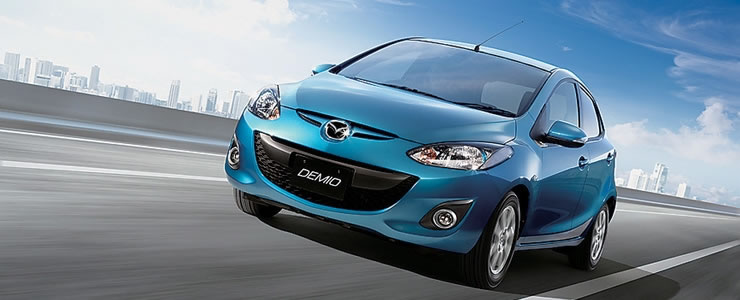 |
Last September, Mazda announced that its new Demio would be able to clock a fuel consumption figure of 30km/litre despite not being a hybrid. Although their claims were met with much scepticism, Mazda has proven its mettle when it released its new model on 30 June.
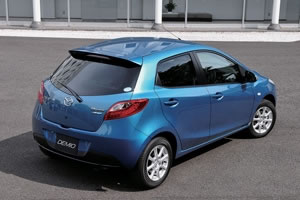
The new Demio receives a modified front grille and bumper that is similar to the model sold in North America. Its main design has been crafted together with the Axela, which embodies the automaker's new design sensibilities. As a result, the new Demio looks much grander.
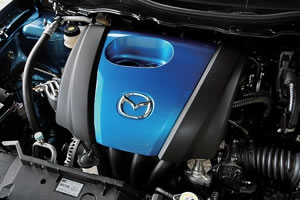
The Demio's most lauded feature is its 1.3-litre direct injection SKYACTIV-G engine. The integration of the Miller cycle allows it to reach a high 14.0:1 compression ratio. Mazda's i-stop Idling Stop function has also been improved, and to reduce the Demio's weight, only one battery has been installed instead of the usual two. iously, it could only be used while the car was in "Drive" mode, but the new version allows the i-stop system to be activated while in "Park" or "Reverse".
The new Demio will be 30 percent more fuel-efficient compared to the current 13C-V variant, which clocks 23km/litre. Overall, the improvement comes from engine enhancement (a 24 percent improvement), the integration of Continuously Variable Transmission (CVT) (two percent) and the installation of aerodynamic parts (four percent). It should be noted that not all the Demio variants will be equipped with the highly anticipated SKYACTIV engine - that honour is reserved for the 13-SKYACTIV option. Aside from its engine, the 13-SKYACTIV also receives a host of features that distinguish it from the Demio's other grades.
 |
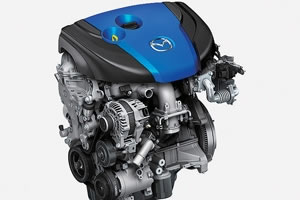 |
 |
 |
 |
 |
Aside from being equipped with Mazda's Eco-drive function, the new Demio also arrives with the new intelligent-Drive Master (i-DM) system. This new feature is the world's first driving assistant, which supports enjoyable driving while encouraging a driving style that optimises passenger comfort and improves fuel efficiency. In the pursuit of safety, Dynamic Stability Control (DSC) and Traction Control have also been included as standard equipment.
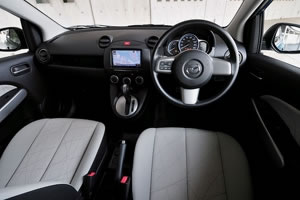
Though Mazda has clearly been focusing on perfecting its SKYACTIV technology, we are happy to note that it has also enhanced the Demio's ride comfort and streamlined its cabin. Not only that, it has also added a fresh selection of colours to its line-up. More impressive is the automaker's attempts to keep prices affordable.
Driving the dream
Mazda has seen its fair share of technical flops. When its Miller cycle engine was first tested, the groove shifted by 30mm, sending the four-door sports car spinning out of control. An early test of its i-stop feature yielded similar results. Now that the automaker's eagerly awaited SKYACTIV technology has arrived, one has to wonder whether it will run without a hitch.
Fuel efficiency is the name of Mazda's game. Last year, I tested its 2.4-litre conventional engine and was surprised to discover that its fuel consumption was 20 per cent better compared to similar engines. As previously stated, the 1.3-litre SKYACTIV-G engine reaches an unheard of 14.0:1 compression ratio, even without the integration of the 4-2-1 exhaust manifold. This will enable Mazda to achieve its goal of improving fuel efficiency by 15 to 20 per cent. An insider disclosed that while the automaker had planned to introduce the engine to the market as soon as possible, it decided to fit it in the new Demio for practical reasons.
Many enthusiasts are enthralled by the novel SKYACTIV technology. Its main objective is to improve the engine's basic function - i.e., the optimum combustion of fuel - by raising the compression ratio as high as possible. This is particularly important in racing engines, where high compression ratios yield improved performance. The regulation of heat is just as crucial in engines that consume less fuel, but the problem is that raising compression ratios result in abnormal combustion, which in turn results in engine knocking. Its efficiency will eventually and inevitably drop as well.
Another advantage of the SKYACTIV engine is its use of the Miller cycle. In regular engines, intake volume is always equivalent to the exhaust amount. For example, a 1300cc intake will yield an identical exhaust amount. However, the Miller cycle-equipped SKYACTIV engine takes in less air and emits more exhaust gases. For instance, it obtains 1170cc of air and expels 1300cc while cruising. The intake amount expands thanks to higher temperatures and pressure in the combustion chamber, and therefore results in higher exhausts.
The new Demio also sports a Continually Variable Transmission (CVT), which improves control of the car and results in better handling. While torque is lower because revolution speed is capped at 1000rpm during city drives, it is boosted by improved acceleration. In conventional engines, frequent acceleration is frowned upon because of fuel consumption concerns. However, in the high compression and Miller cycle-equipped SKYACTIV, it reduces the resistance of inlet air flow, which is commonly referred to as "pumping losses".
When the Demio is idle, its revolution speed is limited to 1000rpm to control fuel consumption. When the engine speed falls below 900rpm, more fuel will be burned to prevent the engine from stopping. Furthermore, the fuel ECO-run technique reduces pumping losses and cuts fuel consumption through enhanced acceleration. The frequency and condition of the Demio's Idling Stop has been reviewed, and stopping time has been substantially prolonged compared to the Axela.
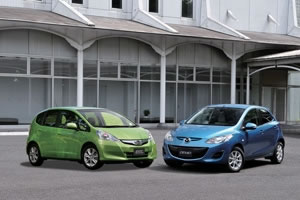
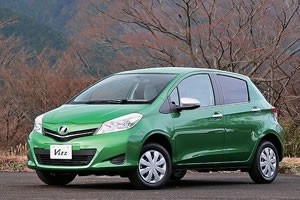
In terms of fuel consumption, the Demio's closest competitor is Honda's Fit Hybrid, whose figures are closely similar to Demio's. While cruising in downtown Tokyo, the Fit consumes about 16km/litre of fuel, while it clocks around 19km/litre in less congested traffic. Other rivals are the Toyota Vitz and Nissan March but Mazda is determined not to give up without a fight.
Dynamic Stability Control (DSC), sideslip control and a rear spoiler come as standard equipment in Demio, which costs ¥1.4 million*. It will be intriguing to see how the Fit Hybrid, Vitz and the Idling Stop-equipped March will meet the challenge that the Demio poses.
Mazda's next move
While I have dubbed the new Demio's SKYACTIV-G engine as "Version 0.5", it is actually nicknamed "Version 5.5" within Mazda. In the automaker's reckoning, Version 1 alludes to the forerunner of its "Zoom-Zoom" campaign, which means that the model with full SKYACTIV equipment will inevitably be Version 6, which is slated for its debut this year.
When the remaining high temperature exhaust gas is discharged, the rising temperature in the engine's cylinders is controlled even if the combustion rate escalates. Mazda's research indicates that reducing the remaining gas from eight to four percent will raise the compression ratio from 10.0:1 to 13.0:1. During compression at the piston's top dead centre, the combustion chamber's temperature can be retained at 800°C, which prevents knocking. Additionally, in direct fuel injection systems, the fuel's potential heat of evaporation provides a cooling effect and raises the compression ratio by an additional point, resulting in Demio's 14.0:1 compression ratio. The higher the compression ratio, the more effective the engine's heat management, and maximising this at the normal opening angle of the accelerator will raise torque by 15 percent. The effect is especially pronounced when the car is driven.
As impressive as the current SKYACTIV-G engine is, Mazda is not stopping there. In 2013, the improved engine will be fitted with a new cooling system and may be combined with a hybrid system. It will be equipped in the next Axela, making the car the first hybrid of its kind in the world. It is only unfortunate that Mazda seems to have no intention of releasing an Axela-class hybrid with a 1.5-litre engine.
Another technology to watch for is the SKYACTIV-Drive transmission system. Increasing the lock-up range will enhance the system's efficiency and will allow it to reach the level of Volkswagen's Direct-Shift Gearbox (DSG), which has the same effect as twin clutch automatic transmission. Furthermore, transmission time will be significantly shortened and combining it with a turbocharged engine will eliminate time lags. SKYACTIV-Drive will be fitted in Mazda's "Version 6", which launches next year.
Our only concern about Mazda is its inherent weakness in establishing a strong brand image, which is especially crucial for a car to reach the bestseller list. But since the automaker has already released a technology as advanced as the SKYACTIV series, we think that we can legitimately keep our hopes up.
*All prices are based on the Japanese automotive market.
 |