When thinking about technology and the future, it is often both equally fascinating and frightening. And it is clear that technology, and the way we as humans deal with it, is a perplexing topic that demands grappling with. Classic dystopian literature like H.G. Wells' The Time Machine in 1895, Aldous Huxley's Brave New World in 1932 and George Orwell's 1984 all imagine a future in which technology has become an integral part of human existence, long before the emergence of things like Facebook and Twitter. And it seems clear that there is always a certain apprehension towards technology, perhaps because of its inherent superiority over flawed humanity.

One could argue that its much the same with cars. Karl Benz is credited with inventing the first car powered by an internal combustion engine in 1886, 130 years ago. With cars, there has been more technological advancement in the past 30 years than in the preceding century. Features that we may take for granted - electric power steering, electric windows, Anti-lock Braking System (ABS), Traction Control - all only became commonplace in cars towards the late 80s.
As companies strive towards greater technological heights (with futuristic technology like autonomous driving), it's clear that the timeline on technological advancement continues to get shorter and shorter. Mercedes-Benz is very much on the forefront of such technological development - we recently attended the Mercedes-Benz Driving Event (MBDE) Singapore to drive a whole suite of Mercedes cars to better understand the technologies that underpin modern Mercs and to search for some answers on what technology means for cars, as well as for us as drivers.
Understanding what you cannot see
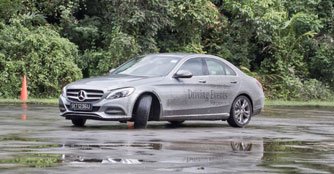
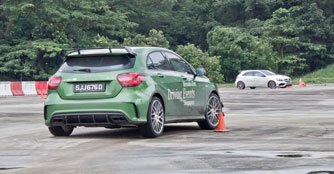
At the MBDE, two stations were set up to highlight such technologies. The first is what's best described as a giant drift pan, to highlight the car's Electronic Stability Program (ESP). Normally best demonstrated on snow, our car's rear wheels were fitted with a special plastic cover that simulates snow conditions.
With the ESP turned off, going anywhere near the throttle results in the tail immediately kicking out - big slides, doughnuts and lots of sideways action are par for course. However, with the ESP turned on, it is literally impossible to spin the car. The program regulates power delivery and braking to ensure maximum traction even on low-traction surfaces.
Control and decision making
As we increasingly move towards an autonomous motoring future, there is obviously a stark sense of anxiety as to what this means for us as drivers. With the wealth of driving assistance systems, is the driver rendered useless? The simple answer is no. As the Mercedes trainer reiterates, the car's assistance systems can help you, but they are not legally allowed to make decisions for you. Therefore, driver initiative is still key. In most circumstances, the car still requires driver input before it can act. It can help you steer, help you accelerate and brake, help keep you safe, but it will not decide for you - it can only decide with you.
At this point in time, then, there are still limits on autonomous technology. The technology itself is certainly there - in two years time, Mercedes expects to have all the necessary technology for a fully-autonomous vehicle. However, there are obviously still legal and moral limits that need overcoming.
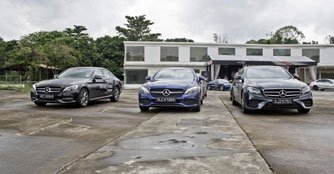
The MBDE has clearly demonstrated that cars are becoming ever smarter. Mercedes claims its new E-Class is the world's smartest executive saloon - it has more computing power than an Airbus A380, and more computing power than all of NASA when they put a man on the moon. It has a dizzyingly comprehensive suite of safety technologies that makes driving easier, safer, and perhaps better. It is then paramount that we understand these technologies, before we can even talk about embracing them.
But technology has its limits, and it's inevitably a human limit. Are we as drivers independent of the technologies helping us? Are we learning to be safer, more conscientious and better drivers? And as we move forward, are we willing to embrace autonomous technology and sacrifice our driving autonomy? As it is, we cannot be entirely dependent on such technologies, thinking that modern technology will get us out of every sticky situation. The driver still matters - we are the decision makers; we are the ones in control. Technology is there to augment us, not to replace us. At least not yet.