The Hyundai Motor Company has unveiled a strategic roadmap to accelerate its electrification ambition as it pursues sustainable progress for the company.
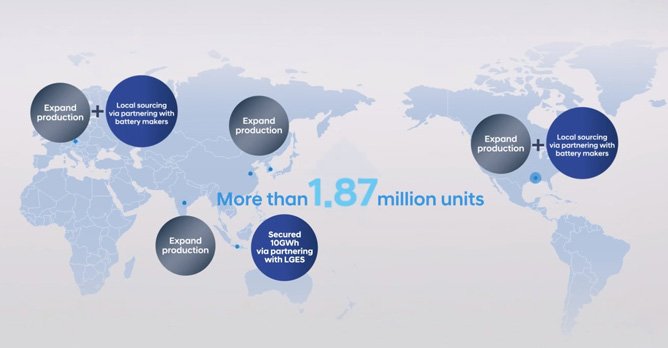
To start, the firm raised its annual battery-electric vehicles sales target to 1.87 million units by 2030 from the previously announced 560,000 units by 2025. This translates, Hyundai states, to approximately 7% of the global market share of battery electric vehicles.
 Hyundai has announced that it plans to take up to 7% of the global battery electric vehicle market share by 2030 The firm also announced that it will be introducing a total of 17 new all-electric models, with 11 from its Hyundai marque, and six to come from Genesis by 2030.
Of the 11 new Hyundai models, six will be SUVs, three will be sedans, while a new light commercial vehicle, and a final still undisclosed model is planned. Sales of the Ioniq 6 are scheduled to start by 2022, followed by Ioniq 7 in 2024.
On the manufacturing front, the Hyundai Motor Global Innovation Centre here in Singapore is set ot get a high efficiency manufacturing process for BEV production. This process is described as a flexible production system, which will utilise advanced level automation and digital twin technology. The manufacturing process will be expanded to global plants in the future.
Beyond existing BEV production facilities centered in Korea and the Czech Republic, Hyundai also plans to gradually expand its battery electric vehicle manufacturing bases, starting its recently announced Indonesian plant, already set to begin manufacturing of electric vehicles this year to help expand production volume.
The firm also announced that it is targeting an operating profit margin of 10% or higher in electric vehicles by 2030. This feat, it states, will be accomplished by increasing sales volume and continued innovation to bring down manufacturing costs.
To start, the firm raised its annual battery-electric vehicles sales target to 1.87 million units by 2030 from the previously announced 560,000 units by 2025. This translates, Hyundai states, to approximately 7% of the global market share of battery electric vehicles.
Of the 11 new Hyundai models, six will be SUVs, three will be sedans, while a new light commercial vehicle, and a final still undisclosed model is planned. Sales of the Ioniq 6 are scheduled to start by 2022, followed by Ioniq 7 in 2024.
On the manufacturing front, the Hyundai Motor Global Innovation Centre here in Singapore is set ot get a high efficiency manufacturing process for BEV production. This process is described as a flexible production system, which will utilise advanced level automation and digital twin technology. The manufacturing process will be expanded to global plants in the future.
Beyond existing BEV production facilities centered in Korea and the Czech Republic, Hyundai also plans to gradually expand its battery electric vehicle manufacturing bases, starting its recently announced Indonesian plant, already set to begin manufacturing of electric vehicles this year to help expand production volume.
The firm also announced that it is targeting an operating profit margin of 10% or higher in electric vehicles by 2030. This feat, it states, will be accomplished by increasing sales volume and continued innovation to bring down manufacturing costs.